
الهه کمالی
September 2, 2026
Fire Alarm Control Panel
Fire Alarm Control Panel
What Is a Fire Alarm Control Panel?
Importance of Installing a Fire Alarm Control Panel in Buildings
Types of Fire Alarm Control Panels
Conventional Fire Alarm Control Panel
Addressable Fire Alarm Control Panel
Main Components of a Fire Alarm Control Panel
How a Fire Alarm Control Panel Operates
Conclusion
الهه کمالی
Fire Alarm Control Panel
The fire alarm control panel is considered the most essential component of any fire detection and alarm system. It serves as the central unit responsible for coordinating all system elements and maintaining communication with the various connected devices. In the following sections, we will explain what a fire alarm control panel is and how it operates.
What Is a Fire Alarm Control Panel?
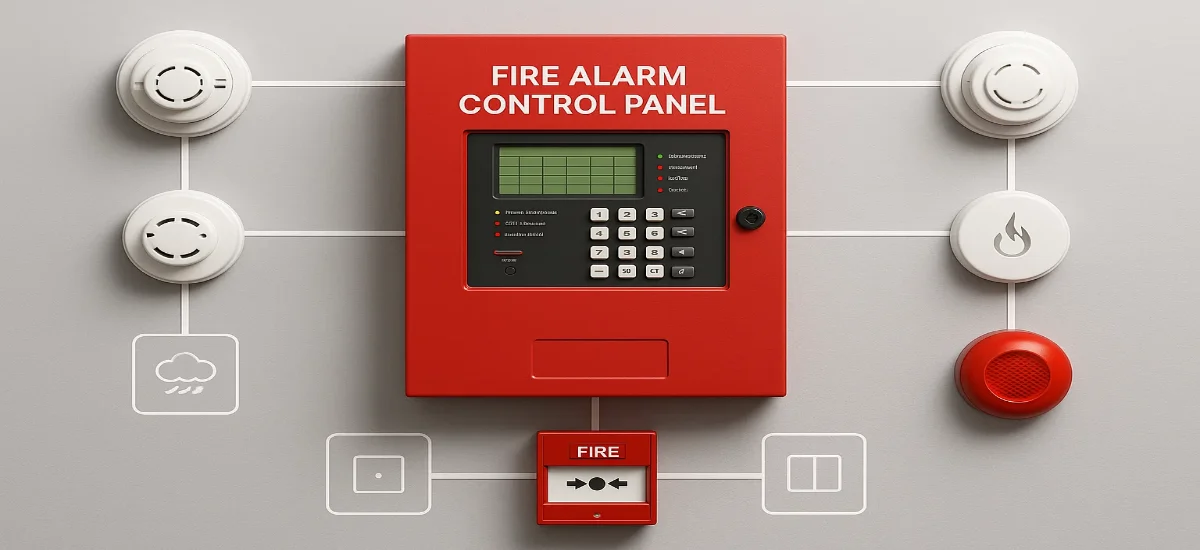
A fire alarm control panel is an electronic device that functions as the command center of the entire fire alarm system. All sensors, detectors, manual call points, and notification appliances are connected to this panel and transmit their information to it. In addition, the control panel continuously monitors the system’s health, and if any fault occurs in wiring, sensors, or power supply, it identifies and reports the issue.
Importance of Installing a Fire Alarm Control Panel in Buildings
Coordination between components in a fire alarm system is crucial. If the devices are unable to communicate properly, timely detection of fire may be compromised. Some key benefits of fire alarm control panels include:
- Reduced response time to fire
- Continuous monitoring of sensors and devices
- Fast and accurate alarm notification to occupants
- Compatibility with smart systems and automatic fire suppression
- Prevention of financial and human losses
Types of Fire Alarm Control Panels
Fire alarm control panels are available in two main types:
- Conventional panels
- Addressable panels
Before selecting a panel for your building, it is necessary to understand both types and know their differences. Below, we examine each type and discuss their main features.
Conventional Fire Alarm Control Panel
When using a conventional panel in a building, the structure must first be divided into several zones, each containing equipment appropriate for its function and layout. Each zone may represent a general area or an entire floor. If any sensor within a zone detects signs of fire, the conventional panel identifies and displays the zone in which the activated detector is located.
Addressable Fire Alarm Control Panel
Addressable panels are more advanced than conventional models. In an addressable system, all devices are connected on a single loop, and the wiring is arranged in a ring configuration so that the end of the circuit returns to the control panel. If a detector sends a fire signal, the panel displays the exact location of the activated device.
Addressable panels are classified by the number of loops, typically available in single-loop, two-loop, four-loop, and up to eight-loop models.
Main Components of a Fire Alarm Control Panel
A fire alarm control panel consists of several internal components, each with a specific function. These include:
- Electronic board: Processes all input and output signals
- Display (LCD/LED): Shows detector status, zones, and system faults
- Keyboard or control keys: System configuration, alarm reset, and menu navigation
- Power supply: Provides the required operating voltage
- Backup battery: Ensures continued operation during power failure
- Zone circuits or addressable loops: Interface with detectors and notification devices such as sounders
How a Fire Alarm Control Panel Operates
After learning about different panel types, it is also important to understand how they are operated. These systems are generally designed for ease of use, ensuring that building personnel can operate them effectively in both normal and emergency situations.
In normal operation, the system remains in standby mode, and the green indicator light shows that all detectors and devices are functioning properly. If a detector senses unusual smoke or temperature, it sends a signal to the panel. The panel then switches to alarm mode, activates the red indicator light, and triggers the building’s alarm sounders. The panel’s display shows the zone number or the exact address of the activated detector, enabling faster identification of the potential fire location. After inspection and once the issue is resolved or identified as a false alarm, the operator can use the Reset button to return the system to normal.
Keys:
- Reset: Clears the panel memory and restores normal operation
- Evacuate: Used to test the system devices
- Silence Alarm Sounder: Mutes the alarm sounders
Indicators:
- Green LED: Indicates normal operation and that the panel is active
- Red LED: Indicates a fire alarm condition
- Yellow LED: Indicates a system fault
Conclusion
In conclusion, the fire alarm control panel is essentially the heart of the system. Through continuous monitoring of both the environment and system components, it fulfills critical safety expectations.